


A garage door can be easy to ignore until it starts waking everyone up, leaving a gap at the bottom, or refusing to close when you’re trying to leave for work. When that happens, the first question is usually, “Do I need a whole new door?” Sometimes the answer is yes. Often, though, the sensible starting point is a closer look at what has actually worn out.
For Suffolk County homeowners, there are a few practical questions worth asking before agreeing to a replacement.
Is the door damaged, or is one component causing the trouble?
A noisy opener doesn’t automatically mean the door needs replacing. Neither does a cracked weather seal or a remote that suddenly loses range. A technician should look at the door itself, its balance and movement, the tracks and rollers, the springs and cables, and the opener before recommending a complete replacement.
A door with badly damaged panels, significant corrosion, structural distortion, or repeated problems may be a different story. The point isn’t to repair everything at any cost. It’s to understand whether the part you’re paying to replace is really the source of the problem.
Don’t try to adjust torsion springs or tensioned cables yourself. Those components can release dangerous amounts of stored energy. If a cable is loose, a spring is broken, or the door seems unstable, stop operating it and have a qualified professional inspect it.
Measure the opening, but don’t assume that tells the whole story
People often describe a garage door as “a single” or “a double,” but that doesn’t tell a contractor enough to price every job accurately. Width and height matter, of course. So do headroom, side clearance, track configuration, the condition of the existing hardware, and the type of opener.
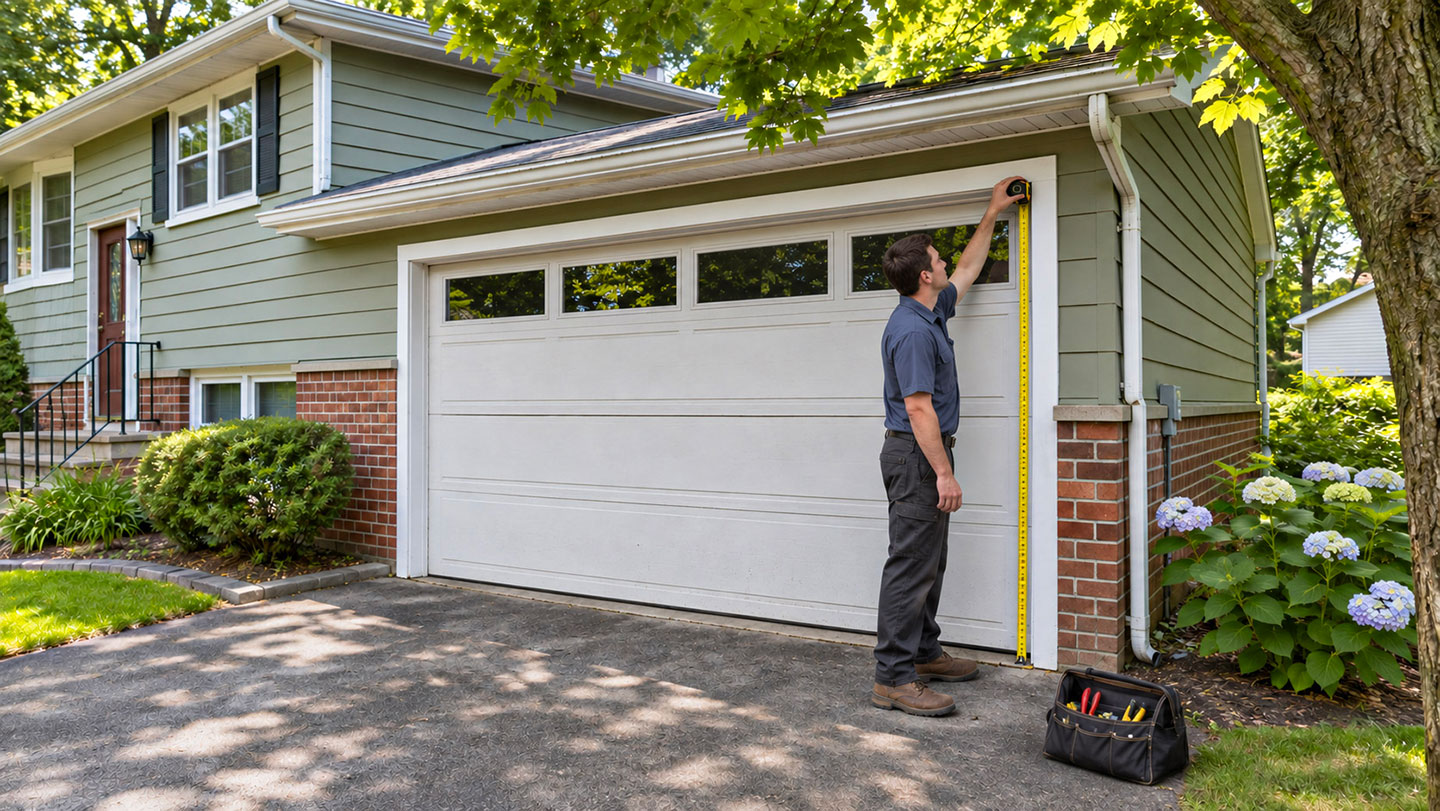
It’s perfectly reasonable to take basic measurements and send a photo before requesting an estimate. Just remember that a final installation plan may require an on-site assessment. A standard-size door and a custom-size door can have very different material and installation requirements.
Think about insulation in the context of the space
An insulated door isn’t automatically necessary for every garage. If the garage is detached and used mostly for parking, a straightforward replacement may be enough. If it is attached to the house, used as a workshop, or sits beneath a living area, insulation and sealing deserve more attention.
Ask what the door construction actually includes rather than relying on a generic “insulated” label. It also helps to inspect the perimeter seals. A new door won’t stop every draft if there are large gaps around the opening.
Long Island weather can make maintenance more important
Moisture, temperature changes, wind, and, nearer the coast, salty air can all make routine inspection worthwhile. Look for rust on exposed hardware, worn bottom seals, water collecting near the threshold, and rough or uneven travel. A small maintenance issue can be less expensive to address before it damages another component.
None of this means homeowners should service high-tension parts themselves. Visual checks and keeping the area around the door clear are one thing; spring and cable work is another.
Ask what the estimate actually includes
Two quotes can look dramatically different until you compare the details. Does the price cover the door, standard installation, removal of the old door, new tracks, springs, an opener, and sales tax? Are the existing components suitable for reuse? If additional work becomes necessary, when will the homeowner approve it?
A good estimate should explain the scope clearly, not force you to guess from one attractive number. Get the final scope in writing before work begins.
Choosing a local garage door company
Look for a company that can explain the problem in plain language, describe the available options, and identify the parts of the estimate that depend on inspection. Verify the business’s licensing where required and review the terms of any stated warranty.
As with any contractor, ask questions, compare the actual scope, and choose the solution that suits the door and the property.
The best outcome isn’t always the newest or most expensive door. It’s a door that fits the opening, operates safely, and comes with a clear explanation of what you’re paying for.